

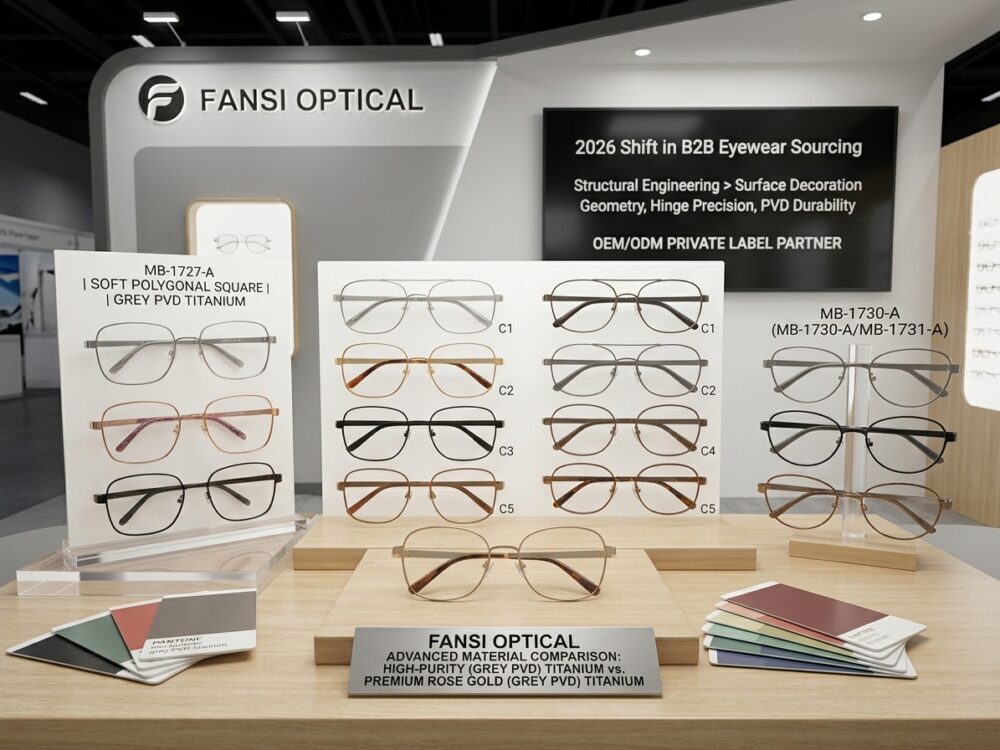
In the evolving global B2B optical market, the traditional playbook for driving high retail markups is losing traction. For years, European and North American distributors relied on heavy surface embellishments—such as glued-on temple plaques, intricate top-bar inlays, and decorative crystal accents—to justify luxury price points. However, procurement directors, independent brand owners, and optical retail chains are now confronting a costly reality: surface-applied decorations are the single largest contributor to post-sale customer returns and warranty claims.
As we move into 2027, top-performing optical brands are shifting away from decorative excess in favor of architectural ergonomics, cold-forged component integration, and low-tolerance lens rim geometry. For wholesale buyers looking to maximize gross margins while reducing defect rates below 0.5%, understanding this manufacturing transition is essential to building a high-converting catalog.
1. Cold-Forged Hinge Mechanics vs. Applied Temple Embellishments
The most vulnerable point in any metal eyeglasses frame is the hinge-to-temple junction. Traditional decorative frames frequently experience structural failure at point-of-contact glue joints or soldered trim pins. When subject to daily temple flexing, thermal expansion, or accidental over-extension, applied trims dislodge, leading to expensive store credit refunds and damaged brand reputation.
To solve this, advanced optical manufacturers have replaced glued trims with cold-forged ribbed and knurled hinge integration (such as the textured mechanical elbows featured in the MB-1691 and MB-1692 series).
- Micro-Milled Structural Integrity: Instead of attaching secondary decorative components, the tactile ribbed pattern is cold-forged directly into the monoblock titanium or high-density alloy temple component. This creates a single, unbreakable mechanical unit that handles continuous stress without structural fatigue.
- Tactile Sophistication: Micro-milled grooves create light-refracting textures along the temple elbow. This provides an executive, handcrafted aesthetic that commands premium retail pricing without adding unnecessary weight (keeping frame weights between 23.0g and 27.0g).
By sourcing frames with integrated structural knurling rather than glued accessories, optical buyers eliminate the root cause of trim detachment claims while offering consumers authentic mechanical luxury.
2. Direct-Fit Lens Rim Geometry: Reducing Glazing Labor and Lens Popping
For high-volume optical labs and retail chains, frame processing speed directly impacts bottom-line profitability. Improperly tensioned metal eye wires or inconsistent rim bevel angles cause significant delays during prescription lens mounting, frequently leading to lens popping, frame distortion, or cracked high-index lenses.
Modern geometric frames (such as soft square navigators like the MB-1688 and MB-1689, or slim oval profiles like the MB-1690 and MB-1693) are engineered with computer-numeric-controlled (CNC) lens groove tolerances.
- Optimized Lens Groove Depth: Standardizing the V-bevel groove depth across geometric shapes allows optical technicians to glaze lenses faster with zero manual rim reshaping.
- Versatile Prescription Depth: Oversized navigators and geometric soft squares provide vertical lens depths (up to 41.5mm) optimized for seamless fitting of progressive, bifocal, and digital blue-light filtering lenses without compromising field-of-view geometry.
Sourcing frames designed specifically for automated glazing labs reduces lab labor costs per unit and guarantees a secure lens fit for end-users.
3. Advanced PVD Plating: Ending Sweat Corrosion and Nickel Reactions
A primary concern for wholesale buyers expanded into coastal or high-humidity markets is finish degradation. Standard wet-electroplated finishes deteriorate rapidly when exposed to skin oils, cosmetics, and sweat, resulting in plating flaking, green copper oxidation, and nickel-allergic contact dermatitis.
To ensure long-term frame durability, premium factory suppliers have migrated to vacuum Physical Vapor Deposition (PVD) coating protocols:
- Atomic-Bond Wear Resistance: PVD technology deposits high-purity titanium and metallic nitrides in a vacuum chamber, bonding the color layer to the core metal at an atomic level. This yields scratch resistance up to four times higher than conventional lacquer coatings.
- Color Uniformity Across Batches: PVD coating ensures exact color consistency across entire production runs—whether producing satin black (C1), deep gunmetal (C2), or warm rose gold (C4/C5)—eliminating shade variance between catalog samples and bulk shipments.
- REACH & FDA Compliance: Sealed PVD finishes prevent heavy metal leaching, ensuring full compliance with EU REACH regulations and US FDA medical device standards for wearable eyewear.
4. Evaluating OEM/ODM Manufacturing Capabilities for Private-Label Success
Building a scalable private-label eyewear line requires a manufacturing partner capable of translating technical specifications into consistent, market-ready volume production. When auditing an optical factory for bulk supply, procurement managers should focus on three critical operational benchmarks:
- AQL 1.0 Sampling Verification: Ensure your supplier conducts rigorous Acceptance Quality Limit inspections, testing hinge torque, temple alignment, and plating adhesion prior to final packaging.
- Laser Engraving Precision: Request clean, high-contrast inner-temple branding and size coding (e.g., 51-20-140 or 57-17-145) that will not rub off during prolonged wear.
- Low MOQs for New Colorways: Partner with flexible manufacturers offering manageable Minimum Order Quantities across core colorways, allowing you to test market demand before committing to large-scale inventory capital.
Elevate Your Optical Catalog for 2027
The future of profitable eyewear distribution lies in structural engineering, ergonomic precision, and long-lasting material integrity. By pivoting your sourcing strategy toward cold-forged hinge detailing, CNC-milled geometric frames, and advanced PVD finishes, your brand can minimize return rates, enhance customer loyalty, and capture high-margin optical market share.