

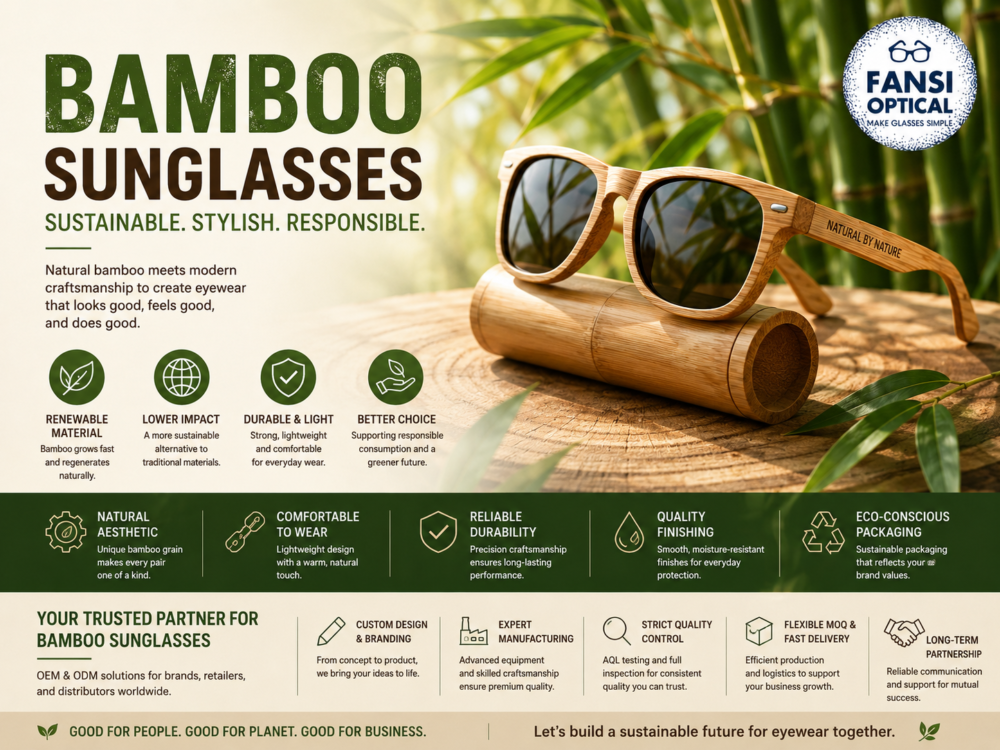
The eyewear industry is entering a new phase where consumers are looking beyond fashion and asking a more important question: What is my eyewear made from, and how responsibly was it produced?
For brands, distributors, retailers, and importers, this shift is creating new opportunities for natural-material eyewear. Among the alternatives gaining attention, bamboo sunglasses stand out because they combine a distinctive natural appearance with a strong sustainability story.
But bamboo is not automatically a better product simply because it comes from a plant. For B2B buyers, the real question is whether the material, manufacturing process, durability, finishing, and supply chain can meet commercial expectations.
Why Are Bamboo Sunglasses Becoming More Popular?
Bamboo is technically a fast-growing grass rather than a traditional tree, and it can regenerate after harvesting. This gives it an important advantage as a renewable raw material. Bamboo-based eyewear can also provide a different visual and tactile experience from conventional plastic or metal frames.
For consumers, the natural grain and individual texture of bamboo create a sense of craftsmanship and authenticity. For brands, this creates an opportunity to build a product story around nature, design, craftsmanship, and responsible consumption.
Sustainability is also becoming a more relevant purchasing consideration in eyewear. Industry research shows increasing consumer interest in sustainable materials, while younger consumers in particular are placing greater importance on sustainability, craftsmanship, and product longevity.
This makes bamboo sunglasses particularly interesting for lifestyle brands, eco-conscious retailers, outdoor businesses, boutique eyewear brands, and private-label collections.
The Environmental Advantages of Bamboo
One of the strongest arguments for bamboo is its renewability.
Compared with conventional petroleum-based plastics, bamboo can provide a plant-based alternative for certain frame applications. The environmental performance of bamboo eyewear, however, depends on the complete production chain—not simply the fact that bamboo was used.
A typical bamboo sunglasses manufacturing process may involve harvesting, cutting, shaping, sanding, polishing, assembly, finishing, and lens installation. Some manufacturers combine machine precision with hand-finishing to preserve the natural characteristics of the material.
For B2B buyers, this means sustainability should be evaluated across the entire supply chain:
Raw Material → Processing → Manufacturing → Finishing → Packaging → Transportation → Product Life
This is also why responsible manufacturers should avoid making vague claims such as “100% eco-friendly” without explaining the actual material composition and production process.
The Challenges of Bamboo Sunglasses
Bamboo also has limitations.
Unlike injection-molded plastics, bamboo is a natural material with variations in grain, density, and surface appearance. These characteristics are part of its appeal, but they can make consistency and production more demanding.
Moisture, heat, finishing quality, adhesive selection, and structural design all need to be carefully controlled.
Another important consideration is that a “bamboo” frame may not necessarily be made entirely from solid bamboo. Laminated structures, coatings, adhesives, or bamboo-plastic composites can change the environmental profile of the finished product.
This distinction matters for international brands. The European Commission, for example, has specifically warned about misleading sustainability claims involving products that contain bamboo fibers but are actually plastic-based products.
Therefore, a professional sunglasses vendor should be able to clearly explain the actual material composition of the frame rather than relying solely on the word “bamboo” as a marketing claim.
Bamboo vs. Conventional Eyewear Materials
Bamboo should not necessarily replace acetate, TR90, stainless steel, or other established eyewear materials.
Instead, it should be viewed as another material option within a broader product strategy.
For example:
Bamboo: Natural appearance, lightweight feel, strong sustainability story and differentiation.
Acetate: Excellent color possibilities, premium appearance, strong design flexibility and established manufacturing technology.
Metal: Slim profiles, structural precision, lightweight construction and a sophisticated aesthetic.
TR90 / Injection Materials: Efficient mass production, flexibility, durability and competitive unit costs.
For a high-quality sunglasses supplier, understanding these differences is essential. The best material depends on the target market, price point, product positioning, expected order volume, and design requirements.
What Should B2B Buyers Look for in a Bamboo Sunglasses Manufacturer?
Choosing a bamboo sunglasses manufacturer should involve much more than comparing factory prices.
Buyers should evaluate several areas:
1. Material Transparency
Ask where the bamboo comes from and whether the frame is solid bamboo, laminated bamboo, bamboo fiber composite, or another material.
2. Manufacturing Quality
Check how accurately the frame is cut, polished, assembled, and finished.
3. Structural Durability
Hinges, temples, bridge areas, and lens grooves require particular attention because natural materials can behave differently from injection plastics.
4. Surface Finishing
A professional finishing process can improve resistance to moisture, daily wear, and environmental exposure while maintaining the natural appearance of bamboo.
5. Quality Control
A reliable supplier should have documented inspection procedures covering frame alignment, hinge performance, lens fitting, surface defects, and final assembly.
6. OEM & ODM Capability
For private-label brands, customization is increasingly important. Buyers may require custom colors, logo engraving, packaging, lens specifications, and exclusive designs.
These capabilities separate a genuine high quality sunglasses supplier from a factory that simply offers bamboo as another catalog material.
The Future of Bamboo Sunglasses
The future of bamboo eyewear is unlikely to be about replacing every conventional frame material.
Instead, its strongest opportunity may be as part of a broader movement toward material diversification and responsible product design.
The sustainable eyewear market is moving away from simple “green” marketing and toward greater transparency, traceability, and measurable material information. Current industry forecasts also point toward stronger demand for sustainable materials alongside better evidence behind environmental claims.
For brands, this creates an interesting opportunity: bamboo sunglasses can become more than an environmentally themed product. With thoughtful design, reliable manufacturing, premium lenses, high-quality hinges, and professional finishing, they can become commercially attractive lifestyle products.
Conclusion
Bamboo sunglasses offer an appealing combination of natural aesthetics, product differentiation, and renewable-material potential.
However, the future of bamboo eyewear will depend on more than the material itself. Successful products will require thoughtful design, reliable manufacturing, transparent sourcing, durable construction, responsible finishing, and credible sustainability communication.
For eyewear brands, distributors, and retailers, the key is to work with a bamboo sunglasses manufacturer and experienced sunglasses vendor that understands both sustainability and commercial eyewear production.
The question is no longer simply:
“Can we make sunglasses from bamboo?”
The more important question is:
“Can we make bamboo sunglasses that customers want to wear, brands are proud to sell, and retailers can confidently reorder?”
That is where sustainable material innovation becomes a real business opportunity.