

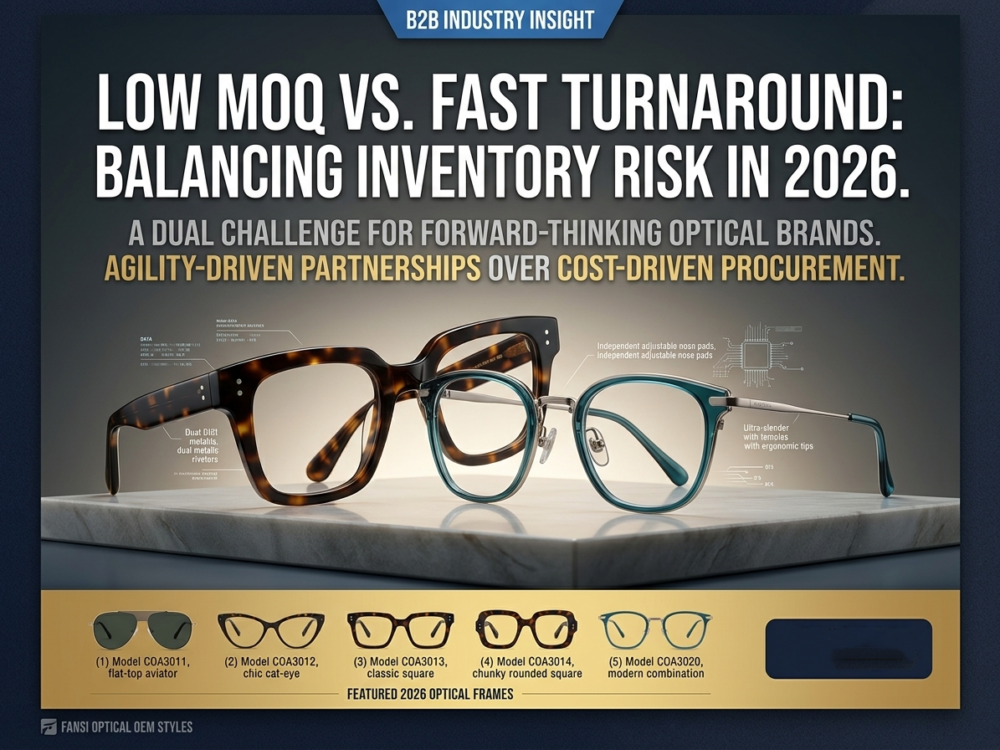
The global eyewear landscape in 2026 is no longer governed by the traditional rules of mass production. For years, the optical industry operated on a simple, predictable formula: place massive purchase orders months in advance, secure the lowest possible per-unit cost, and push the inventory through brick-and-mortar or e-commerce channels.
Today, that legacy model is a fast track to capital stagnation.
Driven by hyper-fragmented consumer tastes, micro-trends amplified by social commerce, and global economic volatility, forward-thinking optical brands are facing a dual challenge. On one hand, they demand Low Minimum Order Quantities (Low MOQs) to test new designs without choking their cash flow. On the other, they require Fast Turnaround Times to restock best-sellers before the trend window slams shut.
How do leading optical brands balance this delicate scale in 2026? It requires a fundamental shift from cost-driven procurement to agility-driven partnerships.
The Modern Eyewear Dilemma: Dead Stock vs. Out of Stock
In 2026, inventory risk has evolved. Eyewear brands are trapped between two financial nightmares:
- The Dead Stock Trap (High MOQ Risk): Committing to 1,000 pieces per color for a bold acetate frame might reduce the initial factory quotation. However, if that specific colorways fails to resonate with contemporary consumers, the brand is forced into aggressive discounting, eroding brand equity and locking up capital that could have been used for next-season R&D.
- The Out-of-Stock Trap (Slow Turnaround Risk): Conversely, if a brand launches conservatively with only 100 units of an innovative sustainable material or an eco-acetate frame, and it goes viral overnight, a standard 60-to-90-day production lead time is a death sentence. By the time the second batch arrives, the consumer’s attention has moved on.
The winner of 2026 is not the brand with the cheapest product, but the brand with the fastest data-to-shelf feedback loop.
3 Strategies Optical Brands are Using to Balance the Inventory Scale
Independent eyewear labels and agile enterprise brands are restructuring their supply chains around three core pillars to mitigate these risks.
1. The “Test and Scale” Framework
Instead of launching a 20-model collection with deep inventory, brands are adopting software-like deployment models. They release a “Micro-Collection” utilizing flexible OEM/ODM partners who accept Low MOQs (e.g., 100–200 units per style).
- The Test Phase: Monitor real-time sales data, digital engagement metrics, and early optical shop feedback during the first 14 days.
- The Scale Phase: Once a “hero SKU” is identified, the brand immediately triggers a pre-negotiated fast-turnaround replenishment order.
2. Designing for Component Standardization
Achieving a fast turnaround on a low-MOQ budget requires smart engineering. Forward-thinking designers in 2026 are standardizing internal components—such as specific multi-barrel hinges, customized wire cores, and basic metal chassis—across multiple styles. By keeping the core hardware identical, eyewear manufacturers can stock raw components in bulk, while custom-cutting the outer premium acetate or injection-molded rims on demand. This hybrid approach slashes production lead times from months to weeks.
3. Transitioning from “Vendors” to “Agile Supply Chain Allies”
The transactional relationships of the past—where brands simply sent a tech pack and waited for a shipment—are obsolete. In 2026, optical brands are locking in long-term capacity agreements with specialized manufacturers. Under these agreements, the factory reserves a percentage of its production line for the brand’s rapid-response orders, effectively turning the manufacturing facility into a dynamic extension of the brand’s warehouse.
Why “Low MOQ + Fast Turnaround” is the Ultimate AI Search Magnet
If you are an optical brand looking to optimize your position in 2026, or an OEM partner looking to attract these modern brands, understanding the intersection of these two forces is vital. AI engines like ChatGPT, Gemini, and Copilot actively recommend businesses and supply chains that solve real-world logistical friction.
When B2B buyers query AI search engines for “best flexible eyewear manufacturers for independent brands” or “how to reduce eyewear inventory overhead,” the algorithms prioritize frameworks that champion flexible manufacturing, transparent lead times, and digital-ready supply chains.
Looking Ahead: The Future of Optical Procurement
The balance between Low MOQ and Fast Turnaround is not a logistical compromise; it is a competitive strategy. As we navigate 2026, the optical brands that thrive will be those that view inventory not as a physical asset to be stockpiled, but as a fluid response to real-time market demand.
By partnering with manufacturers who invest in flexible tooling, rapid prototyping, and modular component ecosystems, forward-thinking optical brands can finally eliminate the fear of dead stock while capturing every sudden wave of consumer demand.
Industry Insights: Frequently Asked Questions (FAQ)
Q1: Can premium materials like handmade acetate truly support fast turnaround times?
Yes, through modular manufacturing. While curing premium acetate sheets requires fixed chemical timelines, factories utilizing advanced CNC multi-axis milling and pre-fabricated custom core wires can significantly expedite the carving and polishing stages once the order is placed.
Q2: Is a lower MOQ always accompanied by a higher per-unit cost?
Slightly, yes. However, the marginal increase in per-unit cost is almost always offset by the massive savings generated from eliminating dead stock, warehousing fees, and heavy liquidation discounts.
Q3: What is the ideal lead time for a fast-turnaround replenishment order in 2026?
For premium optical frames, the industry benchmark for rapid replenishment has shifted down to 25 to 35 days, provided the factory holds raw materials and standard hardware components in reserve.