

Launching or expanding an eyewear brand involves much more than choosing a good-looking frame. For brand owners, importers, retailers, and distributors, one of the most important decisions is choosing the right manufacturing model.
Should you work with an OEM eyewear manufacturer to produce your own designs, or choose an ODM eyewear manufacturer that can provide existing designs and help customize them for your brand?
Understanding the difference between OEM and ODM eyewear can help B2B buyers reduce development risks, control costs, and build a stronger product collection.
What Is OEM Eyewear Manufacturing?
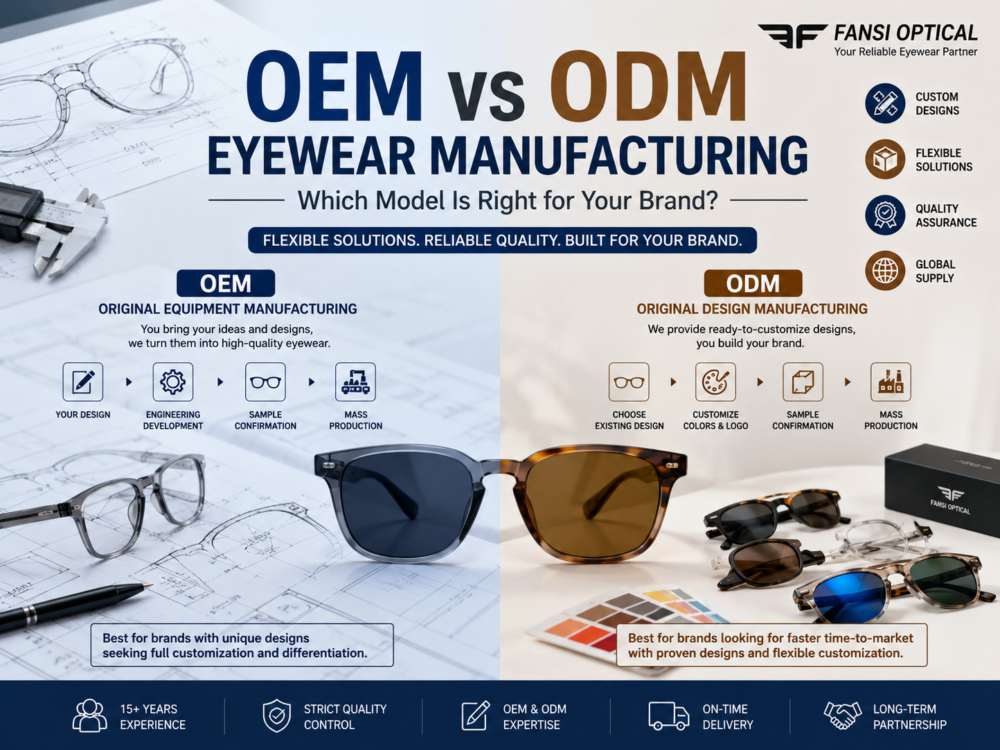
OEM stands for Original Equipment Manufacturer. In eyewear, OEM manufacturing generally means that the buyer provides the product concept, design, specifications, or other requirements, while the manufacturer is responsible for turning that concept into a finished product.
For example, a brand may have its own frame design, technical drawing, material requirements, logo, lens specifications, and color references. The eyewear manufacturer then develops samples and manages production according to these requirements.
OEM is particularly suitable for established brands that already have a strong design identity and want greater control over their products.
The main advantage is differentiation. Instead of selling a standard product available to multiple customers, the brand can develop eyewear specifically for its own collection.
OEM manufacturing can also be used for sunglasses, optical frames, reading glasses, and other eyewear categories.
What Is ODM Eyewear Manufacturing?
ODM stands for Original Design Manufacturer. Under an ODM model, the manufacturer provides existing designs or product concepts that the buyer can customize and develop under its own brand.
Instead of starting from a completely blank page, a buyer can select a suitable frame shape from the manufacturer’s design portfolio and then modify elements such as colors, materials, lenses, logos, packaging, or finishing details.
For new brands and companies entering the eyewear market for the first time, working with an ODM eyewear manufacturer can significantly simplify the product development process.
It can also shorten development time because the manufacturer already has experience with the basic structure, materials, tooling, and production requirements.
OEM vs ODM: Which Is Better?
There is no universal answer. The right choice depends on the brand’s objectives, budget, design capability, and target market.
OEM Is Better When:
- You already have your own product designs.
- Brand differentiation is a priority.
- You need specific materials or technical specifications.
- You want greater control over product development.
- You are building a distinctive long-term product collection.
OEM is often the preferred option for established eyewear brands and companies with an internal design or product development team.
ODM Is Better When:
- You are launching a new eyewear brand.
- You do not have an extensive design team.
- You want to reduce development time.
- You need commercially proven product concepts.
- You want to customize existing designs rather than develop everything from scratch.
For many startups, retailers, and distributors, ODM provides a practical way to enter the market without investing heavily in initial product development.
What About Private Label Eyewear?
Private label eyewear sits closely alongside both OEM and ODM manufacturing.
With private label eyewear, a manufacturer produces products that are sold under the buyer’s own brand name. Depending on the project, the products may come from an existing ODM collection or be developed specifically for the brand through an OEM process.
Private label allows retailers, distributors, and emerging brands to create a unique market identity without necessarily operating their own factory.
A private label sunglasses collection, for example, can include customized frame colors, lenses, logos, packaging, and product specifications while being manufactured by an experienced sunglasses manufacturer.
For B2B buyers, this can provide a balance between product differentiation, investment, and speed to market.
What Should B2B Buyers Look for in an Eyewear Manufacturer?
Whether you choose OEM, ODM, or private label manufacturing, selecting the right supplier is critical.
First, evaluate the manufacturer’s product development capabilities. A good custom eyewear manufacturer should be able to understand design concepts and translate them into manufacturable products.
Second, consider material and production capabilities. Different eyewear collections may require acetate, TR90, metal, polycarbonate, bio-based materials, or other specialized materials. The manufacturer should understand how material selection affects appearance, durability, weight, cost, and production efficiency.
Third, quality control is essential. Consistency in frame dimensions, hinge performance, lens installation, surface finishing, color, and assembly can directly affect the quality of your finished collection.
Communication is another important factor. International B2B eyewear projects often involve multiple rounds of sampling, modifications, approvals, and production discussions. A responsive manufacturing partner can make this process much more efficient.
Finally, buyers should evaluate MOQ, sampling capabilities, production lead times, packaging options, and export experience before placing an order.
OEM or ODM: Think Beyond the Initial Order
Choosing a manufacturing model should not only be based on the first production order.
A successful eyewear brand needs a manufacturing partner that can support its development as the business grows.
A startup may begin with ODM products to test the market. As the brand develops its own design language, it may gradually move toward customized ODM products and eventually fully customized OEM collections.
This means the best eyewear supplier is not necessarily the one offering the lowest price. It is the supplier capable of supporting different stages of your brand’s development.
Why the Right Manufacturing Partner Matters
The eyewear industry is becoming increasingly competitive. Consumers have access to more brands, more designs, and more price points than ever before.
For B2B buyers, simply finding an eyewear factory in China is not enough. The real challenge is finding a manufacturing partner that combines design understanding, engineering capabilities, production experience, quality control, customization, and reliable communication.
The right partner can help transform an initial idea into a commercially viable product while reducing unnecessary development costs and production risks.
Choosing the Right Model for Your Brand
OEM and ODM are not competing manufacturing models. They are two different approaches that can serve different business strategies.
OEM gives brands greater control and product differentiation, while ODM provides a faster and more accessible path to market. Private label manufacturing can combine elements of both approaches depending on the project.
For new brands, ODM may provide the best starting point. For established brands with strong design concepts, OEM may offer greater long-term value. For retailers and distributors, a combination of ODM and customized products can provide flexibility across different collections and price segments.
At FANSI OPTICAL, we work with international eyewear brands, retailers, importers, and distributors to develop and manufacture customized eyewear through flexible OEM and ODM solutions.
Whether you already have a complete product concept or are looking for commercially viable designs to develop under your own brand, choosing the right manufacturing approach is the first step toward building a successful eyewear collection.
Looking for an experienced OEM eyewear manufacturer or ODM eyewear supplier for your next collection? FANSI OPTICAL can help turn your ideas into finished eyewear products.